
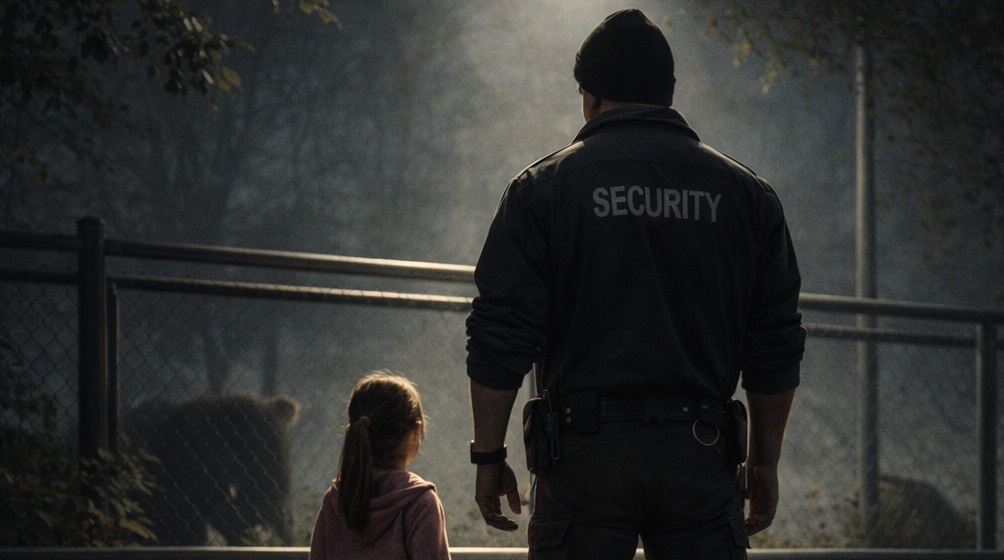
Children, as a general rule, were not considered a security concern.
They were considered a logistical one.
They wandered. They climbed things they shouldn’t. They asked questions that required answers no one had time to give properly. They existed in a constant state of low-level unpredictability that the zoo managed through signage, barriers, and the steady hope that most parents were paying attention.
Most of the time, that was enough.
Tonight, it wasn’t.
Aster noticed the problem before he saw it.
Not because of noise. There wasn’t any.
Because of the gap.
The absence of the usual pattern – footsteps, voices, the soft, constant motion of people moving through space with purpose or without it. There was a space along the path that had… thinned.
Not empty.
Just wrong.
He adjusted his route without thinking about it.
He didn’t need to.
The path he had been walking on stopped being the right one. The one to his left became the right one instead.
That was usually how these things worked.
He found her near the outer edge of the enclosure.
Small. Still. Standing closer to the barrier than she should have been, but not climbing, not reaching, not doing anything that would normally trigger intervention.
Just… looking.
There was no adult immediately beside her.
That was the second problem.
Aster stopped a few paces back.
Not approaching yet.
Observing.
She wasn’t focused on the animals.
That was the third.
“Hi,” he said.
He pitched his voice carefully – not loud enough to startle, not soft enough to be missed.
The child didn’t turn around.
“He’s behind you,” she said.
Aster didn’t move.
“That’s good to know,” he replied.
He stepped forward then, closing the distance with the same unhurried pace he used for everything else.
“Where are your parents?”
The child shrugged, still not looking at him.
“Looking at the monkeys.”
“They´re on the other side of the zoo.”
“I know.”
Aster followed her line of sight.
The enclosure was empty of anything unusual.
Animals where they should be. Space behaving properly. No misalignment, no pressure, no indication of intrusion.
And yet…
The shape of the moment didn’t fit.
“Who’s behind me?” he asked.
The child tilted her head slightly, considering.
“You are,” she said.
Aster paused.
“That’s interesting.”
She turned then.
Looked at him properly for the first time.
Children didn’t do the same kind of filtering adults did. They didn’t edit what they saw to match what they expected. They didn’t smooth edges or ignore inconsistencies.
They just… looked.
“You’re not all the same,” she said.
Aster inclined his head slightly.
“No.”
That seemed to satisfy her.
She turned back to the enclosure.
“There,” she said, pointing.
Aster followed the gesture.
Nothing.
And then…
Not nothing.
A shift.
Small. Almost conceptual. The kind of thing that didn’t change into shape so much as refuse to.
The air along the barrier pressed inward, just slightly. Not enough to distort, not enough to move anything physical.
Just enough to suggest that something had chosen that space and wasn’t entirely committed to being seen.
Aster stepped forward.
The child didn’t move.
He adjusted his position, placing himself between her and the enclosure.
Not shielding.
Aligning.
The space reacted.
Again, not visibly.
But the pressure shifted, recalibrating around him like a system updating its assumptions.
Behind him, the child made a small, thoughtful noise.
“You’re bigger that way.” she said.
Aster didn’t look back.
“Yes.”
“How big are you really?”
Aster thought about the question.
There were answers.
None of them would help.
“Big enough,” he said.
“That’s not a number.”
“Nope.”
The pressure in the enclosure changed.
Not increasing.
Testing.
Like something leaning without committing weight.
Aster adjusted his stance.
The movement was subtle.
But the effect wasn’t.
For a moment, the space didn’t quite agree with itself.
His shadow fell wrong. Not longer. Not wider.
Just… shaped incorrectly.
The line of his shoulders held a fraction too steady. His weight settled in a way that suggested not balance, but readiness – the kind built for impact, for holding ground rather than giving it.
And for a second…
The outline of him wasn’t entirely human.
Not a transformation.
Not visible enough to name.
But the suggestion of something older, heavier, built to meet force directly rather than avoid it.
Then it passed.
The space eased.
The pressure withdrew.
Not gone.
Just… uninterested now.
Aster held position a moment longer.
Then relaxed.
Behind him, the child nodded, as if something had been confirmed.
“Okay,” she said. “That’s sorted then.”
Aster glanced back at her.
“Yes?”
She looked up at him.
“Do you do this a lot?”
“Yes.”
“Does it happen a lot?”
Aster considered.
“Enough.”
She accepted that.
Children usually did.
A voice called in the distance.
Sharp. Frantic. Closer than it should have been.
“Emily!”
The child sighed.
“That’s me.”
“I assumed.”
The parent appeared moments later, breathless, already mid-apology.
“Oh my god, I’m so sorry, she just -she wanders, I only looked away for a second.”
“It’s fine,” Aster said.
“She didn’t climb anything, did she? She knows she’s not supposed to – Emily!”
“I wasn’t climbing,” the child said. “I was just looking.”
“Yes, well, you can look from further back.”
The parent stopped.
Looked at Aster properly.
There was always a moment.
A flicker.
Something not quite matching up.
Then it passed.
It always did.
“Thank you,” they said instead. “I -thank you.”
Aster inclined his head.
“Look after her.”
“Yes. Yes, of course.”
They took the child’s hand.
Started to lead her away.
She went easily enough.
But after a few steps, she looked back.
Not at the enclosure.
At Aster.
“You’re not supposed to fit like that,” she said.
Aster met her gaze.
“Nope.”
She nodded, satisfied.
Then she turned and let herself be led away.
Aster watched until they disappeared around the corner.
The space behind him held.
Normal again.
Or close enough.
He adjusted the line of the barrier – a small correction, barely visible – and stepped back onto the path.
There were still other places to check.
Other patterns to maintain.
He moved on.
Unhurried.
As he always did.
Behind him, the zoo settled. It always did.
Aster walked a few steps more before pausing.
Not because something was wrong.
Because of what she had said.
He considered it briefly.
Then, quietly, to himself:
“They don’t usually say it out loud.”
He resumed walking.
Somewhere behind him, a child’s voice carried faintly across the path.
“…he’s still like that.”
Aster didn’t turn around.
He didn’t need to.
He already knew.
 Asterward.com
Leave a comment