
The call came through just after midnight.
Aster was already moving before the radio finished speaking.
“…male, agitated, possible injury.”
He didn’t need the rest. The direction was enough. Not the words, but the shape of the problem. A disturbance that hadn’t resolved when it should have. Something holding tension instead of releasing it.
He cut across the service path without looking at the map posted by the gate. The route was familiar, but that wasn’t why he didn’t check. The zoo didn’t sit still long enough for maps to matter in that way. Not at night. Not when things pressed against it.
The air changed as he approached.
Not colder. Not warmer.
Just… narrower.
He slowed.
Ahead, the lights around the enclosure burned a fraction too bright, bleaching the edges of shadow rather than softening them. The kind of overcorrection that came when something had already slipped out of balance.
Two figures stood by the outer barrier.
One of them was the vet.
She turned as Aster approached, relief arriving first, then something sharper behind it.
“Good,” she said. “You’re here.”
He nodded once, stepping up beside her.
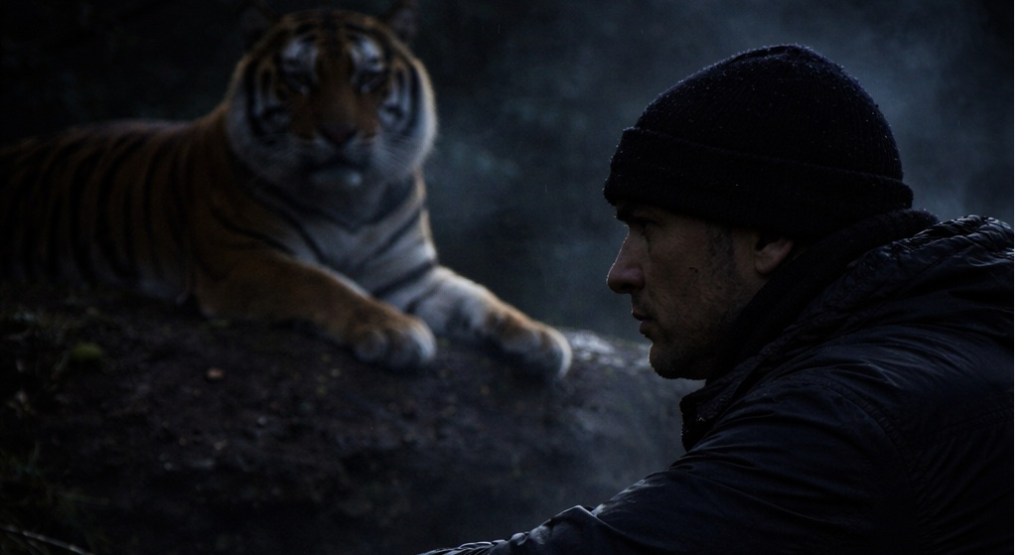
Inside the enclosure, the tiger paced.
Back and forth along the same worn line, its movement too precise to be random, too consistent to be panic. Each turn came at exactly the same point. Each pass followed the same path. There was no variation in it. No attempt to break the pattern.
That was the first thing that was wrong.
The second was the silence.
No low warning sounds. No agitation directed outward. The animal wasn’t reacting to the people outside the barrier, or the lights, or the intrusion.
It was contained within itself.
“What happened?” Aster asked.
The vet exhaled, quick and controlled.
“The keeper found him like this twenty minutes ago. No visible injury, but he’s getting worse. I don’t like the pattern.”
“No,” Aster said. “You wouldn’t.”
She glanced at him, just briefly.
“You’ve seen this before?”
“Yes.”
“Then we´ll have to sedate him,” she said, already turning, already reaching for the case at her feet. “I’m not letting him push himself into collapse.”
Aster didn’t move.
“Not yet.”
That stopped her.
“I’m not asking,” she said. “If he injures himself…”
“He won’t.”
She stared at him properly now, irritation cutting through the professional calm.
“You don’t know that.”
Aster watched the enclosure.
“I do.”
The tiger turned again. Same point. Same step. Same line worn into the ground as if repetition could stabilise something that refused to settle.
Aster stepped past the barrier gate.
Behind him, the vet’s voice sharpened.
“Don’t!”
He didn’t stop.
The gate closed behind him with a soft, automatic click.
The air inside was tighter.
That was the only word for it. Not pressure exactly, but a kind of resistance – as if the space had been drawn inwards, pulled taut around something that didn’t quite fit.
The tiger didn’t react to his presence.
It continued its path. Same line. Same turn.
Aster walked parallel to it, matching pace without crossing the line it had set. He didn’t reach out. Didn’t speak.
He watched.
Counted.
Not numbers. Not steps.
Intervals.
The distance between each turn. The fraction of hesitation that wasn’t hesitation at all, but something catching – something that should have released and hadn’t.
That was where the problem sat.
Not in the body.
In the pattern.
Behind the barrier, the vet had gone very still.
“Why isn’t it reacting?” she said, more to herself than to him.
Aster didn’t answer.
He adjusted his position slightly.
Not closer.
Not further away.
Just enough to stand where the pattern would meet him if it continued unchanged.
It turned again.
Same point.
Same line.
This time, as it reached him, it faltered.
Not a full break. Not a stop.
Just a fraction.
Enough.
Aster shifted his weight.
It was a small movement. Human, at first glance. Nothing dramatic.
But the space responded to it.
The tension didn’t disappear. It… changed.
The line the animal had been following loosened at one end, tightened at the other. Not visibly. Not in a way that could be pointed to and named.
But it changed.
The next pass wasn’t identical.
The turn came half a step earlier.
The line widened.
Behind the barrier, the vet leaned forward.
“What did you just do?”
Aster kept his attention on the animal.
“Nothing.”
“That wasn’t nothing.”
“No,” he said, after a moment. “It wasn’t.”
The animal slowed.
The pattern tried to reassert itself – he could feel that, the way a system attempts to return to equilibrium even when the initial conditions have shifted – but it didn’t quite find its footing again.
The repetition broke.
Not completely.
Just enough.
Aster stepped forward.
This time, he did cross the line.
It stopped.
Not because it was forced to.
Because it chose to.
Its head lifted, attention finally breaking from the path it had carved into the ground. For the first time since Aster had arrived, it looked at something other than the pattern.
The tiger looked at him.
The moment held.
Aster didn’t move.
Didn’t reach.
Didn’t assert.
He just stood there, present in a way that wasn’t confrontational, but wasn’t passive either. A fixed point. Something the animal could orient around that wasn’t the loop it had been trapped inside.
The animal’s breathing slowed.
Aster adjusted his stance again – subtly, almost imperceptibly – redistributing his weight through the ground rather than onto it.
The space responded.
That was the part no one ever saw properly.
Not movement. Not force.
Alignment.
The tension in the enclosure shifted once more, settling into something broader, less precise, less demanding.
The pattern dissolved.
The animal took a step.
Not along the old line.
Away from it.
Another step.
Then another.
It circled once, loosely this time, no fixed point, no repetition driving it forward. The sharpness had gone from its movement. The compulsion with it.
After a moment, it lowered itself to the ground.
Resting.
Not collapsed.
Not sedated.
Simply… finished.
Behind the barrier, the vet let out a breath she hadn’t realised she’d been holding.
Aster waited a moment longer.
Then he stepped back.
The space didn’t resist him now.
He crossed to the gate and let himself out.
The click of it closing sounded louder this time.
The vet didn’t speak immediately.
She was watching the animal, her eyes moving over it with professional focus, checking for signs of distress, residual agitation, anything that might indicate the problem hadn’t actually been sorted.
There was nothing.
Eventually, she turned to him.
“What,” she said carefully, “was that?”
Aster considered the question.
There were answers he could give.
None of them would be useful.
“It was stuck,” he said.
Her expression tightened.
“I know what it was doing. I’m asking how you…”
“It couldn’t stop what it was doing” he said, gently. “So I gave it somewhere else to go.”
“That’s not…” She stopped herself. Reset. Tried again.
“You changed its behaviour? No sedation, no physical intervention, no…”
“Yes.”
“That’s not possible.”
Aster met her gaze.
“I know.”
That didn’t help.
It made something in her expression shift instead . not understanding, not acceptance.
Recognition.
Not of what he had done.
Of the fact that what he had done didn’t fit.
“You shouldn’t be in there,” she said.
He didn’t argue.
“I won’t need to be again tonight.”
“That’s not what I meant.”
He nodded, once.
“I know.”
They stood in silence for a moment.
Behind them, the animal slept.
Not the shallow, guarded rest of something recovering from distress.
Proper sleep.
Even. Deep. Undisturbed.
The vet looked back at it, then at Aster.
“There’s something wrong with you,” she said.
It wasn’t an accusation.
It wasn’t even fear.
It was a statement of fact, arrived at reluctantly.
Aster accepted it the same way.
“Yes.”
No elaboration.
No denial.
Just agreement.
That seemed to unsettle her more than anything else he’d done.
She picked up her case, closing it with more force than necessary.
“I’ll file the report,” she said. “Behavioural anxiety. Environmental factor. Something that sounds like it belongs in a form.”
“That will be fine.”
She hesitated.
“You didn’t touch it.”
“No.”
“You didn’t signal it.”
“No.”
“And it just… stopped?”
“Yes.”
She looked at him for a long moment.
As if trying to decide whether to ask something else.
Something more direct.
She didn’t.
Instead, she said:
“I don’t want to be in there with you again.”
Aster inclined his head.
“That’s reasonable.”
She almost laughed at that. Almost.
But whatever the impulse was, it didn’t quite form.
She turned and walked away instead.
Aster watched her go.
Not tracking her movement. Not evaluating.
Just… noting.
When she disappeared around the corner, he turned back to the enclosure one last time.
The animal hadn’t moved.
The space held.
Balanced.
For now.
Aster adjusted the line of the gate – a small correction, barely visible, but enough to ensure it would close cleanly on the next cycle – and continued his rounds.
There were other places that needed checking.
Other patterns that might not hold.
He moved through the zoo without hurry.
He didn’t need to rush.
He would arrive where he was needed.
He always did.
The zoo would be quiet again now.
For a while at least.
 Asterward.com
Leave a comment