
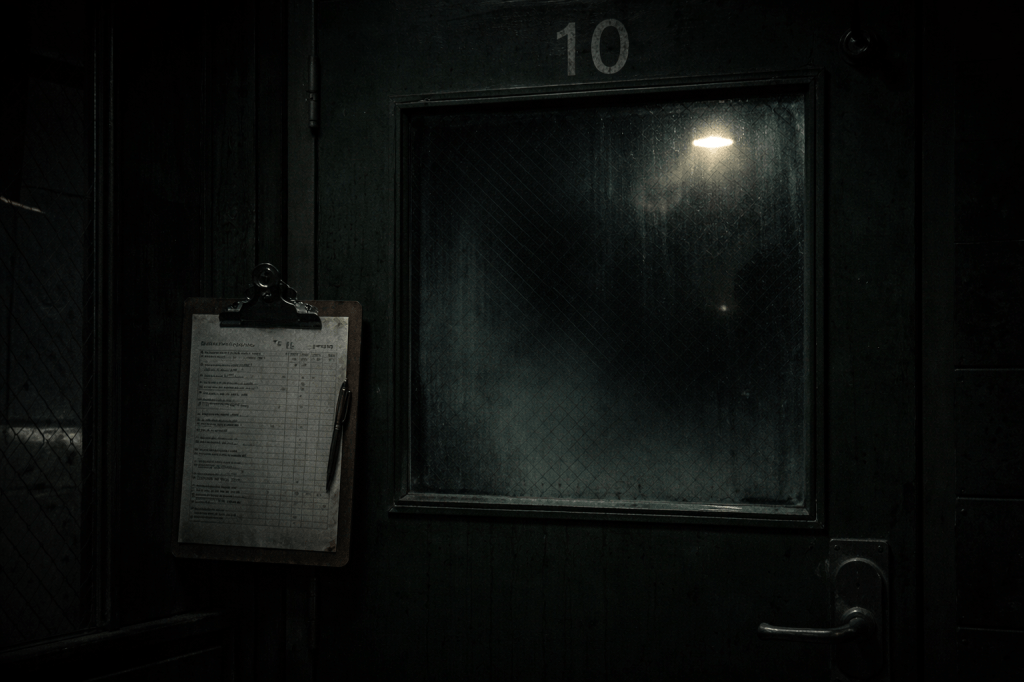
The audit wasn’t supposed to take all night.
It never did. Routine enclosure checks were the kind of work that filled the quiet hours without drawing attention to themselves – something to move through, something to confirm. You walked the paths, checked the locks, signed the sheet. If something was wrong, it usually announced itself in small, practical ways: a latch that didn’t sit properly, a light gone dead, bedding disturbed in a pattern that suggested restlessness rather than sleep.
Most of the time, though, everything was normal. That was the point.
Callum kept the clipboard tucked beneath his arm and angled his torch low, letting the beam fall across the concrete rather than the glass. It wasn’t about silence; the animals were used to noise – doors, voices, the steady movement of people in spaces that technically belonged to them after hours. It was about not startling anything that didn’t expect you. There was a difference between sound and interruption, and he’d learned to respect it.
The first few enclosures passed without incident. Food trays cleared, water refreshed, glass intact. The macaques slept in a loose, breathing cluster, their stillness complete in a way that felt settled rather than fragile. He ticked the box without thinking, moved on, and found the same quiet order repeated again and again. Patterns. That was what the night shift ran on – patterns, and the small deviations that proved the system was still functioning. You learned what “normal” felt like, not just how it looked, but how it sat in your chest when nothing required your attention.
By the time he reached the far end of the corridor, the rhythm had taken him. Walk. Check. Tick. Move on. The kind of repetition that let the mind drift without quite letting go.
It was only then that something failed to settle.
Not wrong, exactly. Not in any way he could immediately name. Just… not placed properly.
He slowed, the torch beam dipping as his attention shifted ahead. The corridor narrowed slightly where the wall jogged inward – a structural compromise from an older layout that had never quite been resolved. He knew it well enough that his body adjusted for it without thought.
The door at the end, though…
He stopped.
It took a moment to understand what he was looking at, not because it was hidden, but because it didn’t align with expectation. It was a standard service door, painted the same institutional green as the others, with a small reinforced window set at eye level. There was nothing unusual about its construction, its placement, or even its wear.
What unsettled him was simpler than that.
It belonged to an enclosure, and he couldn’t remember which one.
Callum shifted the clipboard up and flicked through the sheets until he reached the correct section. Primate house, rear enclosures, numbered in sequence. His finger traced the list – seven, eight, nine – and then paused.
Ten.
There was a line for it. Of course there was. The numbering continued cleanly, without interruption, exactly as it should.
He didn’t remember noticing it before.
He moved closer, his steps slower now, as though the act of approaching required more attention than it should. The door was clean – recently cleaned, in fact. No streaking across the lower panels, no smudges around the handle where hands had pushed without thinking. The observation window had been properly wiped, not given the quick, careless pass that usually marked the end of a long shift.
Everything about it suggested care. Attention. Routine.
He angled the torch up, careful not to shine it directly through the glass.
Inside, the enclosure was dark.
That wasn’t unusual. Lights were kept low overnight, enough for monitoring but not enough to disturb the animals’ cycles. Even so, something about the darkness didn’t quite behave as expected. It didn’t absorb the light so much as deflect it, letting the beam touch the interior surfaces without ever quite illuminating them.
He leaned slightly, adjusting his angle to see past his own reflection.
The space beyond the glass seemed deeper than it should have been. Not larger, exactly – there was no immediate sense of expanded volume – but the far wall didn’t sit where he expected it to. It felt as though the enclosure extended further back than its dimensions allowed, or that the angle of the walls had shifted just enough to prevent his eyes from mapping the space properly.
He blinked and stepped back, letting the light drop again.
“Ten,” he said quietly, as if naming it might settle something into place.
He looked down at the clipboard.
Enclosure 10.
Species…
The line was filled in. That was clear. Ink sat on the page in the same hand as the other entries, consistent, unremarkable.
But the word itself wouldn’t sit still.
He tried to focus on it, to let his eyes settle long enough to read it properly, and found his attention slipping. The shape of the word was there – letters, spacing, something that should have been immediately recognisable – but it refused to resolve into meaning. It was like trying to remember a name that hovered just out of reach, familiar and inaccessible at the same time.
He brought the clipboard closer.
For a moment, it almost came into focus. The word seemed longer than the others, perhaps compound, something that extended beyond a simple label. Then, as he tried to fix it, it shifted – not visibly, not in any way he could track, but enough that when he looked again, the structure felt different.
He lowered the clipboard slowly.
That wasn’t right.
Callum stood there for a few seconds, letting the quiet of the building settle around him again – the low mechanical hum, the distant, occasional movement of something alive behind glass. Routine reasserting itself. Familiar patterns closing in around the anomaly.
“Fine,” he said, more to himself than anything else.
He ticked the box.
He didn’t remember deciding to come back.
One moment he was at enclosure six, noting a loose hinge that would need attention in the morning. The next, he was standing in front of number ten again, the clipboard already open in his hand as if he had been about to check it.
The tick was already there.
He stared at it for a moment, trying to reconstruct the path that had brought him back. The corridor behind him looked exactly as it should – unchanged, continuous, offering no indication that he had doubled back without noticing.
The absence of explanation didn’t feel dramatic. It didn’t demand attention.
It just didn’t settle.
He stepped closer to the door.
The glass was still clean. The enclosure still dark. He angled the torch again, more carefully now, letting the beam slide across the interior.
Something moved.
Not a clear shape. Not even something he could say had form. Just a shift in the darkness, as if part of it had adjusted slightly, drawing back rather than stepping forward.
Callum stilled, his hand tightening slightly on the torch.
“Hello?” he said, automatically.
The word felt misplaced as soon as it left him.
Nothing answered.
Of course nothing answered. It was the middle of the night. Movement didn’t mean anything on its own.
Still, he leaned closer.
The sense of depth was worse this time. The far wall didn’t just seem further away – it seemed misaligned, as though the enclosure wasn’t a simple, contained space but something that angled away from itself, folding just out of sight. His eyes tried to follow the edges and failed, sliding off them in the same way his attention had slipped from the word on the page.
He glanced down at the clipboard again.
Species…
The word was shorter now.
He was certain of it. Whatever he had almost read before had length to it, a structure that suggested complexity. Now the entry felt compact, reduced, something that should have been immediately familiar.
He read it.
Nothing.
The letters were clear. Perfectly legible.
They simply refused to become anything.
A faint unease settled in his chest – not sharp enough to be called fear, but persistent enough that it didn’t dissipate when he looked away.
“Right,” he said quietly.
He ticked the box again.
In the morning, it didn’t present itself as a problem.
It came up the way small inconsistencies always did – half a thought, mentioned in passing, something that might or might not matter depending on how it settled once spoken aloud.
They were in the staff room, the kettle humming, early light filtering in through the high windows in a way that suggested morning without fully committing to it. Callum leaned back slightly in his chair, the clipboard resting on the table between them.
“Enclosure ten,” he said. “What’s in there at the moment?”
Jasmin frowned into her mug, her response automatic at first. “Primates,” she said, then paused, the word losing its certainty even as she spoke it. “No,” she added after a moment. “That’s not right.”
Callum watched her.
“What, then?”
She hesitated, searching for something that should have been immediately available. “It’s… it’s been empty, hasn’t it?”
“No,” Callum said.
He didn’t say it forcefully. Just certain.
She looked at him properly then. “You checked it?”
“Twice.”
That wasn’t entirely accurate, at least not in a way he could account for, but it felt true enough that he didn’t question it.
Jasmin set her mug down and pulled the clipboard towards her, scanning the entry.
“Enclosure ten,” she read. “Species…”
She stopped.
Callum felt the same quiet shift he’d experienced the night before.
“What?” he asked.
Jasmin leaned closer to the page, her brow tightening. “That’s… odd.”
“What is?”
“I can read it,” she said slowly. “But I don’t know what it is.”
Callum let out a small breath.
“Same,” he said.
She looked up at him, something uncertain passing between them. “That’s not how that works,” she said. “You either know the animal or you don’t.”
“I’m telling you…”
“I can see the word,” she said, tapping the page lightly. “It’s right there. But it’s not… landing.”
The word sat between them, present and unusable.
She straightened slightly, her attention shifting from confusion to something more deliberate.
“Who signed this off?” she asked.
“Three shifts,” Callum said. “All normal.”
She scanned the initials.
“Yeah,” she said after a moment. “That’s everyone.”
The silence that followed wasn’t heavy yet. It hadn’t had time to become anything like that.
“Let’s go look,” she said.
In daylight, the enclosure behaved exactly as it should.
That was the first problem.
There was no distortion, no suggestion of depth extending beyond its boundaries. The far wall sat precisely where it should, the angles clean and measurable. The space was empty – but not unused. Bedding had been laid recently and properly. Water was fresh. Enrichment objects had been placed with care, all appropriate for something that should have been there.
Jasmin stepped inside first, her posture cautious but not tense.
“Hello?” she called, more out of habit than expectation.
Nothing answered.
Callum stayed just outside, watching.
“You said you saw something,” she said.
“I thought I did.”
She crouched to examine the bedding, running her hand lightly across its surface.
“This has been disturbed,” she said. “Not recently, but not long ago either.”
“I checked it last night,” Callum said.
“Through the glass,” she replied, without looking up. “That’s not the same thing.”
He didn’t argue.
She stood and moved to the far wall, pressing her hand against it briefly as if to confirm its solidity.
“Nothing hidden,” she said. “No access points.”
Callum stepped inside then, slowly.
The space felt normal.
That was what made it wrong.
It didn’t carry any of the unease from the night before. No slipping, no distortion. Just an empty enclosure, properly maintained, functioning exactly as expected.
He looked back at the door.
“At night,” he said, “it’s different.”
Jasmin glanced at him.
“In what way?”
He searched for the right word, something that would hold long enough to communicate what he’d felt.
“Deeper,” he said finally. “Like it doesn’t stop where it should.”
She held his gaze for a moment, then nodded once.
“Okay,” she said.
Not convinced.
But not dismissing it either.
By the second night, no one discussed it.
They didn’t need to.
The adjustment happened quietly, in the way people moved rather than what they said. Routes shifted slightly. Time spent near enclosure ten shortened without being consciously reduced. No one lingered at the glass.
Callum noticed himself doing it without deciding to. Delaying that part of the check. Approaching it later, as though placing it further along the sequence would make it easier to absorb.
It didn’t.
At 02:11, he stood in front of the door again.
The enclosure was dark.
Deeper.
The same sense of space not quite resolving returned, stronger this time. He didn’t raise the torch. He didn’t want to see more of it, didn’t want to give the space the kind of attention that might allow it to settle into something clearer.
He could feel it, though.
Not a presence.
Not exactly.
Just an awareness that the space wasn’t empty in the way it had been during the day.
He glanced down at the clipboard.
The word had changed again.
He didn’t try to read it.
Behind the glass, something shifted.
Closer this time.
Not enough to see.
Enough to feel.
A small, involuntary tension ran through him, the body recognising something the mind couldn’t articulate.
He ticked the box without looking away.
On the third day, they decided to open it.
No formal meeting. No written directive. Just a shared understanding that observation wasn’t enough anymore.
They needed to confirm.
They stood in front of the door together, the three of them, in the middle of the day. The enclosure looked entirely normal again. Clean. Contained. Empty.
Jasmin reached for the handle.
“Ready?” she asked.
No one answered.
She opened it.
The space inside was empty.
That was the first thing.
The second was that it wasn’t the same space Callum had stepped into the day before.
It was deeper.
Not in a way that altered its measurable dimensions, but in a way that resisted being mapped. The far wall didn’t sit properly in his perception. It seemed to shift slightly as he looked at it, never quite settling into a fixed position.
Jasmin stepped inside, her movement slowing almost immediately.
“Do you see that?” she said.
Martin stayed at the threshold. “See what?”
“The back,” she said. “It’s…”
She didn’t finish.
Callum stepped in beside her.
The air felt still.
Too still.
Not the quiet of an unused space, but something more complete than that, as if the absence of movement had been maintained deliberately.
“It’s further,” he said.
Jasmin nodded, a brief flicker of recognition crossing her expression.
Martin followed reluctantly.
“It’s the same,” he said quickly. “It’s exactly the same.”
Callum didn’t respond.
He was watching the far wall, trying to fix it in place.
His gaze kept slipping.
He took a step forward.
Then another.
The distance didn’t close as it should have. He knew how long the enclosure was supposed to be. His body knew it. The number of steps required should have been fixed, predictable.
The wall remained just out of reach.
“Stop,” Jasmin said.
He hadn’t realised he was still moving.
He stopped.
The wall didn’t come any closer.
Behind them, the door felt further away than it should have been.
Callum turned.
The opening was still there, unchanged in size, unchanged in shape.
Just… not as near as it should have been.
“Okay,” Martin said, his voice tight. “That’s enough.”
Jasmin nodded.
They turned back.
This time, the distance behaved normally. Each step closed it cleanly, predictably, until they crossed the threshold and stepped out into the corridor.
The space snapped back into place behind them.
Contained.
Ordinary.
Jasmin closed the door.
They stood there in silence, looking at the glass.
The enclosure was dark again.
Deep.
Unsettled.
“Right,” Martin said eventually. “We´ll log it. We should tell someone.”
Callum nodded.
Jasmin didn’t move.
She was still watching the enclosure.
“What?” Callum asked.
“It’s not empty,” she said quietly.
He followed her gaze.
At first, there was nothing.
Then something shifted – close to the glass, not quite separate from the darkness behind it, but not fully part of it either. A distortion more than a shape. Something that refused to resolve the longer he looked at it.
“It’s been here the whole time,” Jasmin said.
Martin shook his head. “No,” he said. “No, it hasn’t.”
“It has.”
Callum didn’t speak.
He was watching the space just beyond the glass, trying to hold it in his vision.
It wouldn’t settle.
The more he focused, the more it seemed to slip, as though direct attention made it harder to perceive rather than easier.
Then, subtly, it shifted.
Not away.
Closer.
Not in distance, but in awareness – like something turning its attention back.
Callum stepped back.
“Close it,” he said.
Jasmin didn’t move.
“Close it,” he repeated, quieter now.
She turned to him, something in her expression no longer uncertain.
“It already is,” she said.
Callum shook his head, his eyes still fixed on the enclosure.
“No,” he said. “I mean…”
He didn’t finish.
He looked at the door, at the glass, at the space beyond it that wasn’t empty and wasn’t visible and wouldn’t settle into anything he could name.
His voice dropped.
“Close it,” he said again.
A pause.
Then, quieter still:
“Before it notices.”
Continue the story Coming Soon
 Asterward.com
Leave a comment