
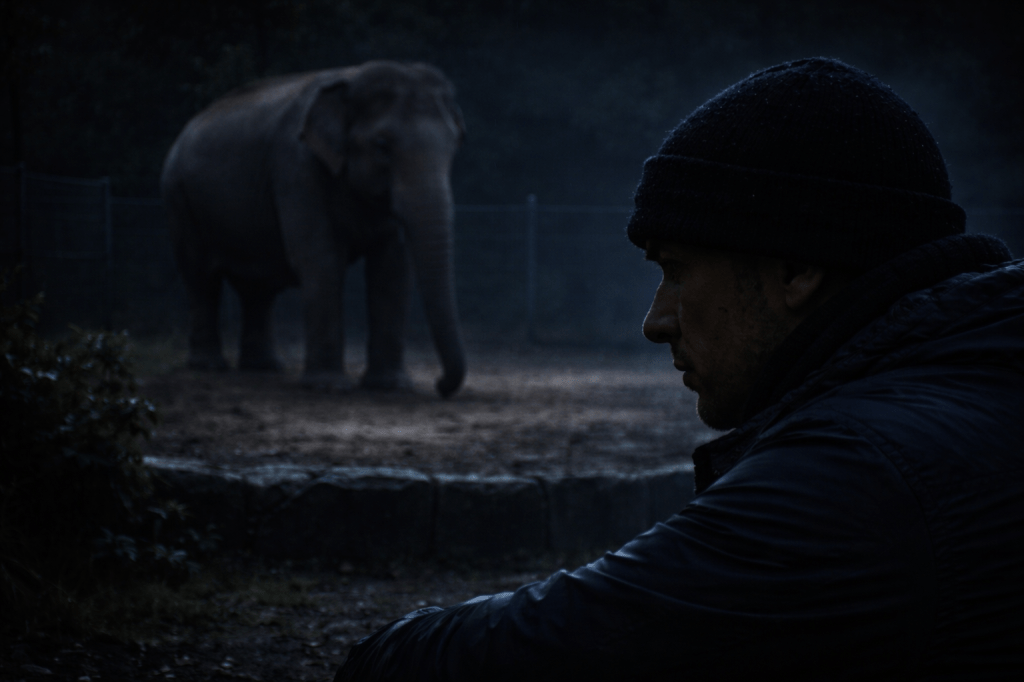
The last of the visitors had gone an hour ago, and the zoo had already begun its quiet transition into something more structured. It never became silent – silence would have implied absence – but it did become ordered. The irregular noise of the day dissolved gradually, voices and footsteps replaced by something more consistent, more self-contained. Movement remained, but it no longer competed. Each enclosure held its own rhythm, each system its own weight, and the space between them stopped asking to be noticed.
Aster waited for that shift to complete itself before stepping outside.
He stood just beyond the office door for a moment, keys resting loosely against his palm, radio clipped but not yet checked, listening as the building settled around him. There were still traces of the day – residual warmth, the faint smell of people – but those were already thinning. What mattered was the structure beyond the walls. Something large shifted its weight behind reinforced glass, water moved through filtration systems in slow, continuous cycles, and air circulated through vents designed to be ignored. He let those sounds come together rather than apart, waiting until they aligned into something that held without effort.
Only then did he move.
The air outside had cooled, the heat of the day draining away from concrete and stone and leaving behind something sharper, cleaner. He closed the door carefully, not allowing the latch to snap, and stepped forward onto the path. This was the first check, not written down, not required, but more reliable than anything he would log later. He didn’t scan the enclosures or look for anything specific. He simply stood, letting the zoo register him in the same way he registered it. Presence meeting presence.
The response came slowly, a subtle redistribution rather than a reaction. No enclosure pulled harder than another, no sound carried further than it should, and nothing pressed at the edges of his awareness. It held. For now.
He adjusted the position of his radio, checked the weight of his keys, and began his route.
The outer paths were the easiest to read, their surfaces maintained, their lighting evenly spaced, their behaviour predictable unless something disrupted them. Aster passed the first enclosures without slowing, his attention resting not on the centre of the path but on the edges, where deviations revealed themselves first. A fox shifted in sleep somewhere beyond his line of sight, a bird resettled against wood, and a distant gate gave a familiar, low rattle as the temperature dropped. All of it aligned. Nothing drew his focus. Nothing asked to be corrected.
He moved deeper.
The zoo changed as he did, not physically but structurally. The further he went, the less the space responded to the expectation of being observed. Paths curved for function rather than flow, lighting softened, and sound behaved differently, holding longer in some places while disappearing entirely in others. Aster adjusted without thinking, slowing where shadow deepened, quickening where sound multiplied, always moving in a way that allowed the space to absorb him without disruption.
By the time he reached the midpoint of his route, everything remained as it should be.
He rested a hand briefly against the low stone wall that edged the path, feeling the cool, dry surface under his fingers, and for a moment the zoo was perfectly balanced. Nothing was wrong.
That was when he felt it.
It wasn’t a sound, and it wasn’t movement. It was a pressure, low and constant, brushing against his awareness without turning into anything he could identify. It didn’t repeat, didn’t intensify, didn’t announce itself as a problem. It simply existed, like something waiting to be recognised before deciding what to do next.
Aster didn’t react immediately. Instead, he let his attention widen, allowing the surrounding systems to define the shape of the deviation through their behaviour. Nothing had failed, nothing had broken, and yet something had shifted in a way that had not yet made itself visible.
He exhaled slowly and continued.
He noticed the elephant enclosure before he saw it, not through sight but through the way the space ahead failed to settle. Something in the distribution of it´s weight was wrong – not heavier, not louder, just incomplete.
Aster slowed as the enclosure came into view.
The elephant was already moving, which in itself was not unusual. Elephants did not rely on stillness in the way smaller animals did; their size required constant adjustment, subtle shifts in weight that maintained balance rather than disrupting it. Movement was part of their equilibrium. There was nothing inherently wrong in the sight of it.
He did not stop walking at first. He simply watched.
The elephant moved along the edge of the enclosure, following a worn path that curved naturally around its boundaries. Its pace was steady, neither hurried nor slow, each step placed with quiet certainty. It passed the water trough without pausing, continued along the fence line, and rounded the far corner with a smooth shift in weight that carried through its body without interruption. At a glance, everything about the movement was correct.
Aster reached the barrier and stopped.
His attention shifted, not to the movement itself, but to where it would end.
Every system had a point of completion, even those that appeared continuous. For an animal of this size, that point mattered. It was where weight settled fully, where breath aligned with structure, where the body completed its cycle before beginning another. Without that moment, the system could not resolve.
The elephant approached that point now, a slightly worn patch of ground where repeated presence had compressed the earth into something firm and reliable. It reached it, stopped, and began to adjust.
The first movement was correct. The front foot planted, weight shifting back slightly to accommodate it. The rear leg repositioned to balance the change. The trunk lowered, not fully but enough to test the space, and the ears shifted once, then again, as the body redistributed itself around the new stance.
Aster watched closely.
This was where the system should have settled.
It didn’t.
The front foot lifted again, only slightly, enough to break the contact it had just established. The rear adjusted again, the trunk shifted without purpose, the ears moved, and the weight redistributed once more. Each movement was correct in isolation, mechanically sound, entirely consistent with how the body should function. But the sequence did not finalise. It continued, repeating without repetition, each action completing itself but never leading to stillness.
After a few seconds, the elephant shifted forward again, not settling but abandoning the attempt, and turned smoothly back onto its path.
Aster remained where he was.
He let the cycle continue.
The elephant followed the same route, identical in every detail. It passed the same points, moved with the same cadence, and returned to the same patch of ground. It stopped, began the same sequence of adjustments, and failed in the same place.
Again.
And again.
Aster exhaled slowly, his attention narrowing not to the movement but to the failure point within it.
This wasn’t pacing. There was no tension, no urgency, no attempt to discharge energy. The route was too precise, too consistent, too complete in itself. What repeated was not the movement, but the attempt to finish it.
The system was looping at the point of completion.
He shifted his stance slightly, grounding himself against the path, and studied the enclosure more closely. Nothing outside the elephant had changed. The lighting remained stable, the air carried no disturbance, and the structure of the space held exactly as it should. The failure wasn’t environmental.
It was internal.
Or deeper than that.
“You’re not just walking,” Aster said quietly, though the elephant did not respond. “You’re trying to finish it.”
The next cycle began, and this time Aster did not wait for it to complete.
He stepped forward, adjusting his position relative to the boundary, then moved through the gate and into the enclosure itself. The change was immediate, not in any visible way, but in how the system registered him. He did not approach directly, nor did he interrupt the route. Instead, he positioned himself just off the worn path, close enough to the point where the sequence failed, but not obstructing the movement that led to it.
The elephant completed its circuit and returned.
Aster adjusted his stance deliberately, placing his feet with care, distributing his weight evenly, allowing his breathing to slow into something steady and controlled. When the elephant reached the point again and began its sequence, he moved in alignment with it – not matching the movement itself, which would have been impossible, but matching the timing of it.
The front foot planted, and Aster shifted his weight.
The rear adjusted, and he adjusted with it.
The trunk lowered, and his breath followed.
The ears moved, and his shoulders settled.
When the sequence reached its final point, where it would normally break, Aster held.
He did not move.
He did not adjust.
He did not allow the system to reset.
For the first time, the sequence stretched.
The elephant’s foot remained in contact with the ground longer than before. Its weight lingered instead of transferring immediately into another adjustment. The trunk lowered further, the ears shifted once and then stopped, and the system – so accustomed to failing at this point – reached for completion.
“You don’t need to stop,” Aster said quietly, his voice low and steady. “You just need the right somewhere to finish.”
The loop attempted to reassert itself, a slight shift in the rear leg beginning to restart the sequence, but Aster did not move. He held his position, not forcing stillness but providing it, introducing a fixed point where there had been none.
Gradually, the movement slowed.
The elephant’s weight settled fully across all four legs, distributing evenly without correction. The trunk lowered and came to rest, the ears stilled, and for the first time since Aster had arrived, the animal stopped moving entirely.
Not briefly.
Not between adjustments.
Completely.
The enclosure held.
Aster remained where he was for a few seconds longer than necessary, confirming the change, ensuring the system had resolved rather than paused. Only when he was certain did he step back, slowly reducing his presence without breaking what had been established.
The elephant did not move.
It had arrived.
Aster exited the enclosure and closed the gate behind him, the latch settling into place with a quiet, definitive sound. He stood for a moment, watching, as the stillness held. The enclosure felt different now – not lighter, not quieter, but complete.
He turned away.
For a brief moment, the zoo beyond felt balanced again, each enclosure holding its centre, each system resolving as it should. The night aligned around him, steady and contained.
Then the feeling returned.
Not from the enclosure behind him, not from the place where the loop had been, but from somewhere else entirely. Faint, distant, and unresolved, the same pressure brushed against his awareness, no longer fixed but moving, threading through the space without following any path he could see.
Aster did not turn immediately. He let it settle, let it define itself without forcing it into shape. It did not remain in one place. It shifted, not along the paths, not across them, but through them, as though the structure beneath the zoo no longer aligned with the surface it supported.
Behind him, the elephant remained still.
The system had been repaired.
But as Aster glanced back once more, he saw that the worn route within the enclosure remained unchanged, neither deepened nor erased, simply present as it had been before.
As if it had never been used.
As if it were waiting.
Aster turned and continued his route.
Routine first.
Always.
But as he moved deeper into the zoo, the feeling returned again, not stronger, not closer, just elsewhere, and this time it did not feel like something failing.
It felt like it was continuing, just on a different path.
Continue the story Coming Soon
 Asterward.com
Leave a comment